
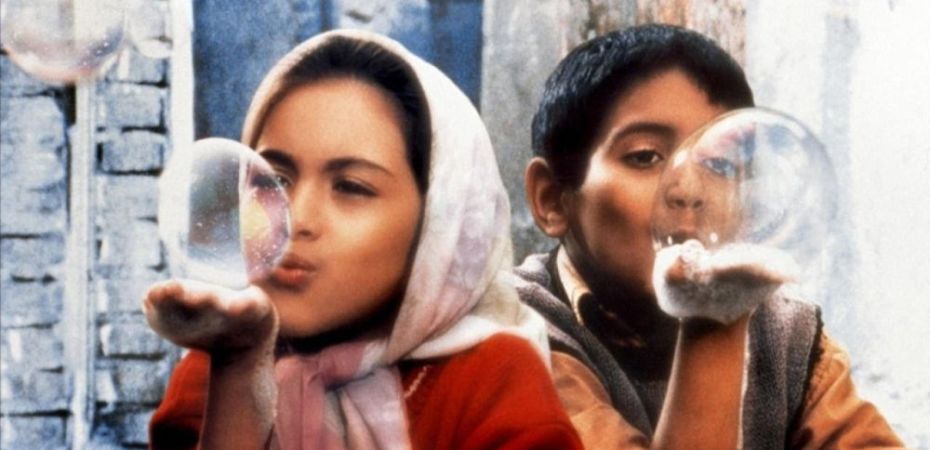
Children of Heaven | Majid Majidi | 89 min | Iran
The film Children of Heaven, directed by the Iranian filmmaker Majid Majidi, is a wonderful story which revolves around a young boy’s adversities. It shows how Ali misplaces his sister Zohra’s shoes and hatches a complex plan to get her a new pair.
In the film, we see how Ali and Zohra are from a poor family, which makes it difficult for them to tell their parents about the lost shoes. The children feel that they will place a burden of luxury on their father who is trying to get a respectable job while their mother is bed-ridden. Perhaps the most touching part of the film are the repeated shots of Ali waiting in alleys waiting for his sister to return from school so that they can exchange the pair of sneakers they now share. The plan works; but it puts both of them in a delicate situation. Zohra has to leave school early – even in the middle of her exams – and Ali ends up getting to school late – much to the chagrin of his headmaster. The children tolerate these hardships to prevent burdening their parents about the loss of the shoes.
Majidi presents the life of ordinary working class families living in Iran. The film provides a concise and clear picture of modern urban life and people’s relations within it. The film was shot in Tehran, the capital city of Iran. It exposes the real face of the city. Most of the scenes are set in the winding back alleys of Ali’s and Zohra’s neighbourhood. We get the general idea that they live in an informal locale contrasted with the skyscrapers and mowed lawns of uptown Tehran. The main intention of the director is to show the contrast in urban planning in contemporary Iran. Apart from this, the film reveals the real life of poor people in Iran – their culture, religion, and will to survive.
It is notable that, in the film, there are not many characters. However, the roles of children are very important. The director uses children to talk about the harsh reality of life in Iran. In the film, the two children act with a maturity that belies their age. We see that they are responsible and faithful towards each other. This reflects the life of ordinary people living in society. But children do not just represent the pains of poverty, but also provide glimpses of hope. In one scene, when we see Ali and his father looking for a job as gardeners, nobody is willing to help them, until a child from a rich family respond to them.
The film, following the style of Iranian New Wave Cinema, is taken in a very realistic manner. The lighting is natural, but very clear. The colours and settings are well composed and laid down. The cinematographer has framed each shot contrasting stillness with movement.
Though the film is very short, it teaches us many lessons. It shows us how children are innocent in their behavior but committed to their responsibilities, how they undergo difficulties but rise up to face these challenges. The film was quite heart-touching; at the same time, it was reflective and meditative.
Sr. A. Chrystal
BA English (VI Sem) (2019 batch)
 Film Society of St. Joseph University